

Oracle (NYSE: $ORCL) share price dropped sharply after its latest earnings report showed revenue below analysts’ expectations, sparking renewed investor concern about whether its heavy investments in AI and cloud infrastructure are paying off.
Revenue Report Misses Expectations
Oracle reported $16.06 billion in total revenue for its fiscal second quarter, which was up about 14 % from the prior year but still below the $16.21 billion that analysts expected.
Despite healthy growth, this shortfall was enough to disappoint the market.
Oracle’s Earnings Per Share (EPS) came in at $2.26, beating the expected $1.64 per share, which is normally positive, but the revenue miss overshadowed that beat.
The company’s Oracle Cloud Infrastructure (OCI) segment, often seen as its most critical growth driver in the AI era, climbed about 68%, roughly in line with forecasts. But even this strong growth wasn’t enough to offset investor disappointment tied to the overall revenue result.
Investors Focus on Future Earnings & RPO
Oracle also reported a huge increase in Remaining Performance Obligations (RPO), a measure of future contracted revenue, which jumped about 440 % year-over-year to $523 billion.
This reflects strong sales contracts signed, but doesn’t guarantee actual revenue recognition in the short term.
Many investors look at RPO as a forward-looking measure of demand, but RPO by itself does not translate immediately into cash flow or near-term earnings, and that dynamic contributed to a shaky reaction from the market.
Stock Price Reaction
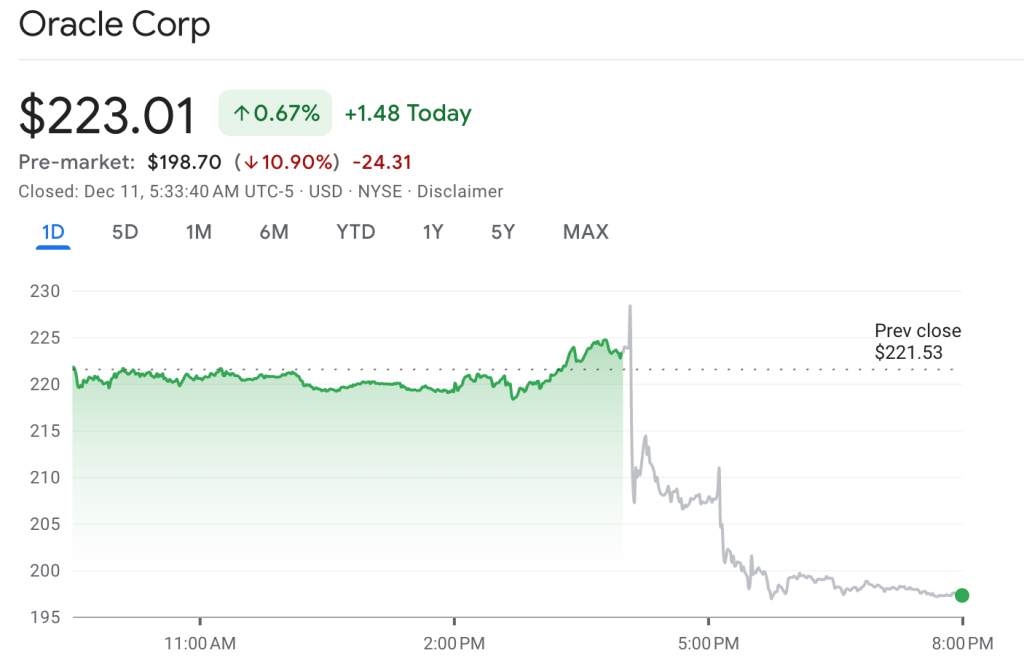
Following the results, Oracle’s stock fell more than 10 % in after-hours trading as Wall Street responded to the revenue miss.
Reports indicate that the stock even traded near $197 in premarket after the earnings release, down sharply from its prior close, a clear sign of market concern.
Why the Market Cared More About Revenue Than EPS
The market’s focus on revenue over EPS in this report reflects a shift in what investors care about: top-line growth and evidence that AI cloud investments are translating into real business expansion.
Even though Oracle beat on EPS, much of that beat was driven by accounting items and not pure operational sales growth. The result was a situation where the market’s expectations for broad top-line acceleration weren’t met, leading traders to re-price the stock lower.
Investor Takeaway
Oracle’s results show that while the company continues to grow (including in its AI cloud segment), missing revenue expectations is enough to weigh heavily on sentiment, especially in a market still sensitive to AI growth and tech execution risks.
The sharp stock drop shows how closely Wall Street watches revenue performance, particularly for companies investing heavily in next-generation technology.
Technical Analysis
When we look at Oracle’s price trends and chart indicators, several points stand out:
Trend & Momentum:
Oracle’s price recently stalled after a strong run earlier in the year and has been in a correction phase where downward momentum has accelerated. Recent technical data shows Oracle trading below key moving averages (20-, 50-, 100- and 200-day levels), which is traditionally a bearish sign in technical analysis.
Indicators such as MACD and ADX have pointed toward continued negative momentum, suggesting the recent drop isn’t just a short pullback but part of a broader downtrend.
Support & Resistance Levels:
Near-term support appears in the ~$192–195 range and around $180, which could act as floors if selling intensifies.
Resistance is around the recent breakdown zone near ~$213–220 and significantly higher around the ~$255+ level, areas the stock would need to reclaim to prove the downtrend is over.
Intermediate Technical Consensus:
Not all technical sources agree entirely: some algorithms show a neutral consensus, with a mix of buy and sell indicators, especially when looking at oscillators like RSI and MACD on shorter timeframes.
Summary Technical View:
The combination of Oracle dropping below key moving averages and trend momentum indicators pointing bearish suggests short-term technical risk outweighs upside momentum.
However, if the stock stabilizes above key support levels and reverses above broken resistance, it could indicate a technical rebound.
Buy, Hold, or Sell: What the Data Suggests
Here’s a straightforward recommendation based on the revenue miss, market reaction, and technical analysis:
HOLD (Primary View)
This is the most balanced position for most investors right now:
- Oracle missed revenue expectations, and the market responded negatively.
- Technical indicators show bearish momentum and a downtrend, but the stock is not in a confirmed collapse, just a correction.
- Analysts’ aggregated data (outside the immediate earnings move) still shows a moderate buy consensus, with more analysts rating Oracle as a buy than a sell, though targets vary widely.
BUY on Weakness (for Long-Term Investors)
Long-term holders can consider adding at lower support levels if:
- Revenue growth accelerates again.
- Oracle proves it can convert AI/cloud spending into consistent top-line results. Investors who believe in Oracle’s cloud and AI strategy might use dips toward major supports (e.g., near $180–$190) as staged entry points.
SELL or REDUCE (Short-Term/High-Risk Strategy)
For traders focused on short-term moves or risk reduction:
- If Oracle breaks below key support decisively, some traders may prefer to trim exposure.
- Those focused on valuation and execution risk over fundamentals might reduce shares until clearer operational progress emerges.
Conclusion
Oracle’s latest earnings brought a revenue miss that spooked the market, and the technical backdrop reflects that pressure with bearish signals and trend weakness.
For most investors, holding and watching price action and upcoming guidance is the prudent strategy, with potential buying opportunities if support levels prove solid.
Longer-term bulls may use weakness as a chance to scale in, while short-term traders should keep an eye on key technical thresholds.
Click Here for Updates on ORCL – It’s 100% FREE to Sign Up for Text Message Notifications!
Disclaimer: This website provides information about cryptocurrency and stock market investments. This website does not provide investment advice and should not be used as a replacement for investment advice from a qualified professional. This website is for educational and informational purposes only. The owner of this website is not a registered investment advisor and does not offer investment advice. You, the reader / viewer, bear responsibility for your own investment decisions and should seek the advice of a qualified securities professional before making any investment. Please read our Full Disclaimer: https://dexwirenews.com/disclaimer/