
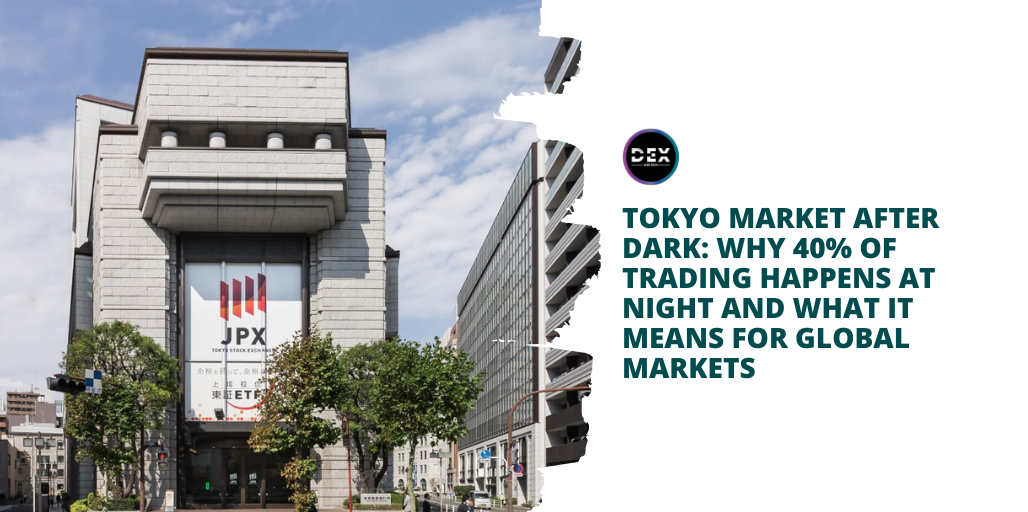
In Tokyo around 40% of all derivatives volume on the Japan Exchange Group (JPX) now happens after the main trading day closes, during overnight or “night session” hours, a fact that stands in stark contrast to most Western exchanges, where extended trading still makes up only a small share of total volume. This change shows deeper trends in how modern markets operate, and it carries implications that stretch far beyond Japan’s borders.
Traditionally, most stock and derivatives trading occurred during daylight hours, tied to the official open and close of local exchanges. But in Japan, the night session now accounts for more than 40% of annual derivatives volume, with 168.5 million contracts traded in 2025, up from 3% in the previous year. In November alone, the after-hours share reached roughly 44.5%, indicating continued growth.
How Tokyo’s Model Differs From U.S. Extended Trading
This change did not happen overnight, it was built on intentional changes by JPX and growing demand from both domestic and international traders. Japan’s night session runs from 4:30 PM to 5:30 AM Japan Standard Time, which means the market effectively stays open through European and U.S. trading hours. This gives investors a way to react to news from around the world even when Tokyo’s standard trading session is closed.
For many foreign investors, this structure is attractive because it allows them to execute trades outside of normal daytime constraints without needing overnight arrangements through other markets. Retail participation has also grown, supported by online brokers that offer easy access to night sessions, helping improve liquidity and volume even when most regional exchanges go dark.
Japan’s success with extended trading stands in sharp contrast to the situation in the United States. Major U.S. brokers and exchanges have introduced extended trading windows and are experimenting with longer hours, but after-hours activity remains a much smaller portion of total volume. For example, Interactive Brokers’ chair noted that overnight trading made up only about 2.2% of volume in mid-2025, a fraction of what JPX had built.
How Japan’s Trading Hours Span Global Markets
One reason Tokyo’s market has been able to grow its night session is that it effectively connects traders across time zones. European and U.S. market developments often occur while Japanese markets are in their night phase. By staying open during these periods, JPX allows participants to react quickly to global economic releases, earnings reports, policy announcements, and geopolitical events without waiting until the next Tokyo morning.
Despite the dramatic growth in night trading, not every market participant or exchange operator sees a push toward fully 24-hour markets as inevitable. The World Federation of Exchanges, an industry body representing the world’s exchanges, has urged caution, recommending extended trading windows of around 22 to 23 hours per day rather than continuous, around-the-clock trading. This reflects concerns around infrastructure, settlement coordination, and market stability.
Alongside derivatives activity, Japan’s cash equity markets also posted strong results in 2025. The Prime Market traded a record 1,419.6 trillion yen, surpassing previous all-time highs. While derivatives volume dipped slightly from the very high levels seen in 2024, the growth of after-hours trading remains a standout trend.
Liquidity, Volatility, and Faster Price Discovery
When Tokyo’s night session overlaps with European and U.S. hours, liquidity can flow across markets more smoothly. This reduces the “dead zones” that historically existed when one major exchange closed and another had yet to open. For traders, it means the global market is effectively more connected than ever before, and price movements can reflect real-time global information rather than delayed adjustments.
Japan’s experience shows one possible path for exchanges around the world trying to balance investor demand for flexible trading hours with the realities of clearing, settlement, and risk management. While fully 24/7 stock and derivatives trading remains complex and expensive to implement, the success of JPX’s night session demonstrates that extended hours can attract volume, increase participation, and support market responsiveness.
In short, the fact that 40% of Tokyo trading occurs after dark is more than a curiosity, it is a sign of how global markets are growing in response to cross-border capital flows, technology, and competitive exchange strategies.
For traders and investors worldwide, it suggests that opportunities, and risks, no longer wait for daylight.
Click Here for Updates on TSX – It’s 100% FREE to Sign Up for Text Message Notifications!
Disclaimer: This website provides information about cryptocurrency and stock market investments. This website does not provide investment advice and should not be used as a replacement for investment advice from a qualified professional. This website is for educational and informational purposes only. The owner of this website is not a registered investment advisor and does not offer investment advice. You, the reader / viewer, bear responsibility for your own investment decisions and should seek the advice of a qualified securities professional before making any investment. Please read our Full Disclaimer: https://dexwirenews.com/disclaimer/