
The Bitcoin (COIN: $BTC) bull market has entered a more difficult phase. Price action is slower, volatility is higher, and confidence is no longer driven by headlines alone. Instead, the market is being shaped by positioning, holder behavior, and cost-basis dynamics.
This is not the type of environment where momentum alone carries price higher. It is a phase where data matters more than narratives. When viewed through that lens, Bitcoin’s bull case remains intact, but only for disciplined participants who understand where risk has shifted.
This editorial examines Bitcoin’s outlook using on-chain profitability metrics, holder behavior, supply dynamics, and macro context to assess whether the current market favors buying, holding, or reducing exposure.
Holder Profitability Shows Resilience, Not Excess
One of the clearest signals of market health is how long participants remain in profit. In weak markets, profitability collapses quickly and stays low. In overheated markets, near-universal profits often precede sharp reversals.
Recent data shows Bitcoin holders spent a majority of the year in profit despite several deep corrections. This suggests the market has been able to absorb downside without triggering prolonged panic selling.
Short-term holders, typically the most reactive group, experienced unrealized losses during pullbacks, but those losses have narrowed meaningfully in recent weeks. Historically, this pattern appears when forced selling pressure is fading rather than expanding.
Cost Basis Has Become the Market’s Pivot
Bitcoin’s realized price, the average on-chain cost basis of coins, is acting as a key psychological and structural level. Markets tend to behave very differently above and below this zone.
Currently, price is oscillating near the average entry price of recent buyers. This creates a narrow decision band. When price holds near the cost basis, sellers lose urgency. When price moves above it, confidence returns quickly. Sustained moves below it, however, often trigger deeper fear-driven selling.
What stands out in this cycle is how quickly Bitcoin has recovered toward this level after corrections. In bear markets, price remains far below realized price for extended periods. That is not happening here.
Long-Term Holders Are Still Anchoring the Market
If Bitcoin were approaching a true cycle top, long-term holders would be distributing aggressively. That behavior marked previous market peaks, when older coins suddenly re-entered circulation.
Current data does not support that scenario. Coins held for more than six months remain largely inactive. Long-term holders continue to control a dominant share of supply, and their selling activity remains limited.
This matters because long-term holders shape the market’s floor. Their refusal to sell into volatility reduces available supply and dampens downside momentum.
Supply Dynamics Still Favor Scarcity
Bitcoin’s supply-side fundamentals remain constructive. New issuance continues to decline structurally, while a growing portion of existing supply is illiquid.
Miner behavior supports this view. There has been no sustained miner capitulation, which typically appears during deep bear markets. Hash rate remains strong, reinforcing network security and long-term confidence.
In markets where supply is tight, price does not require aggressive demand growth to rise. Modest inflows can still have a meaningful impact.
Institutional Demand Has Changed Market Behavior
Institutional participation has altered how Bitcoin trades. Capital entering through regulated channels tends to accumulate during weakness rather than chase breakouts.
This does not eliminate volatility, but it changes its shape. Instead of prolonged crashes, the market now experiences faster corrections followed by stabilization. This makes emotional trading more difficult, but the underlying structure more resilient.
Flows from institutional vehicles have been uneven, but their presence creates a baseline level of demand that did not exist in prior cycles.
Macro Conditions Remain a Risk, Not a Thesis Breaker
Macroeconomic conditions continue to influence Bitcoin’s short-term moves. Interest rates, liquidity conditions, and risk sentiment still matter.
However, Bitcoin’s dependence on perfect macro alignment has decreased. Rather than acting as a binary risk-on asset, it now trades more like a hybrid, sensitive to macro shifts, but supported by internal demand and supply constraints.
This shifts macro from an existential threat to a timing variable. Sharp tightening could pressure prices temporarily, but would not automatically invalidate the broader structure.
Technical Structure Suggests Consolidation, Not Collapse
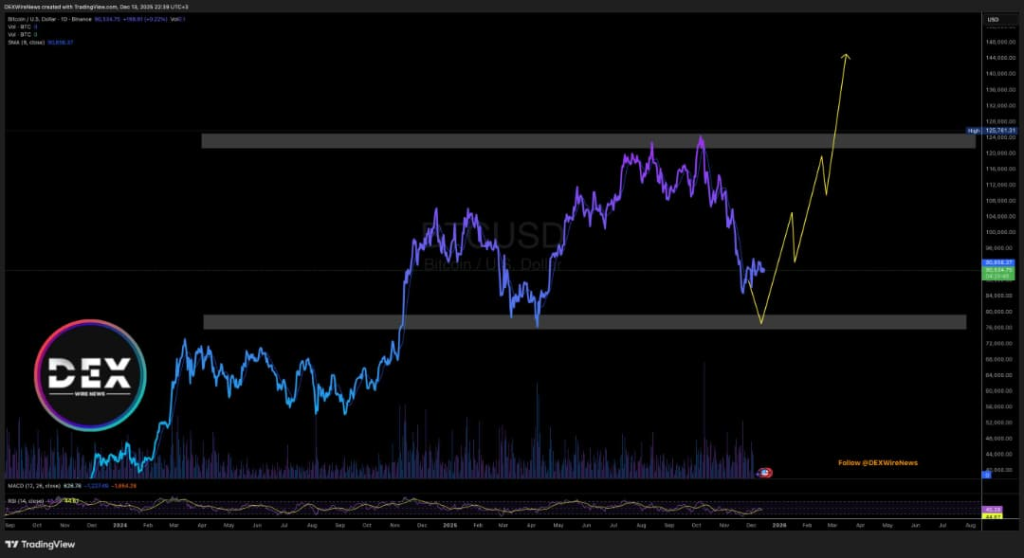
From a technical perspective, Bitcoin remains above key long-term support zones. Momentum has cooled, but trend structure has not broken.
This is typical of late-cycle bull markets, where price alternates between rallies and pullbacks instead of moving in straight lines. These periods test patience and punish leverage, but often reward spot accumulation.
Short-Term Outlook: Elevated Risk, Limited Clarity
Over the next several weeks to three months, volatility should be expected. Price will remain sensitive to macro events and liquidity shifts.
The key short-term question is whether Bitcoin continues to hold near recent cost-basis levels. Losing that zone could invite deeper corrections. Holding it keeps the bull structure intact.
This is not a favorable environment for aggressive leverage. It is a market where risk management matters more than conviction.
Medium-Term Outlook: Structure Still Supports the Bull Case
Looking out three to twelve months, the market’s internal data remains supportive. Long-term holders are steady, supply is constrained, and demand sources are more diverse than in previous cycles.
Returns are likely to be slower and more uneven than earlier in the cycle, but the probability still favors continuation over reversal, unless key on-chain behaviors change.
What Would Invalidate the Bitcoin Bull Case
The bullish outlook would weaken if:
- Long-term holders begin sustained distribution
- Price remains well below the realized cost basis for extended periods
- Liquidity tightens sharply on a global scale
- Leverage rebuilds rapidly and triggers cascading liquidations
These signals matter more than short-term price noise.
Verdict: Selective Buy, Not Blind Conviction
Bitcoin’s bull market is still intact, but it is no longer forgiving. The easy phase has passed. What remains is a market driven by data, discipline, and positioning.
For short-term traders, caution is warranted. For medium-term investors, selective accumulation during weakness still offers favorable risk-reward.
Final stance: Selective Buy / Accumulate on Dips: Bitcoin is not cheap, but structurally, it remains strong.
Click Here for Updates on BTC – It’s 100% FREE to Sign Up for Text Message Notifications!
Disclaimer: This website provides information about cryptocurrency and stock market investments. This website does not provide investment advice and should not be used as a replacement for investment advice from a qualified professional. This website is for educational and informational purposes only. The owner of this website is not a registered investment advisor and does not offer investment advice. You, the reader / viewer, bear responsibility for your own investment decisions and should seek the advice of a qualified securities professional before making any investment. Please read our Full Disclaimer: https://dexwirenews.com/disclaimer/