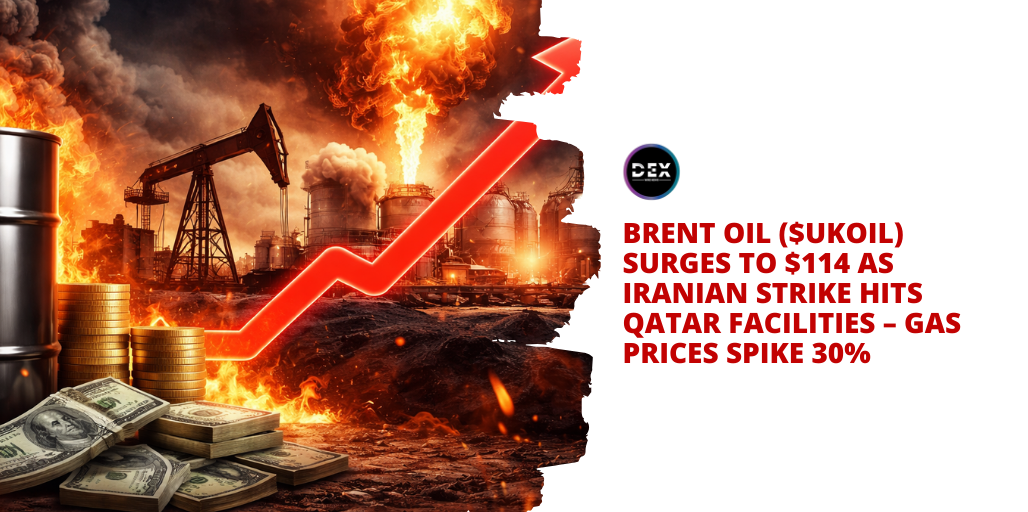
Brent crude oil futures (UKOIL) surged over 6% to more than $114 per barrel on March 19, 2026, marking one of the sharpest single-day moves in recent years. The rally was triggered by Iranian missile strikes that inflicted extensive damage on Qatar’s Ras Laffan Industrial City, home to the world’s largest liquefied natural gas (LNG) export facility.
The attack followed Tehran’s explicit warning that energy infrastructure in US-aligned Gulf states would be targeted in retaliation for Israeli strikes on an Iranian natural gas processing facility.
Escalation Hits Critical Energy Infrastructure
The Iranian strike targeted key loading terminals and storage facilities in Ras Laffan, severely disrupting Qatar’s LNG export capacity. Qatar, the world’s leading LNG exporter, confirmed significant damage to infrastructure critical for global supply. Traffic through the Strait of Hormuz, which handles roughly 20% of seaborne oil, has already been effectively halted for weeks due to the broader conflict. With each passing week of closure, the structural supply deficit in global energy markets continues to deepen.
Saudi Arabia and the United Arab Emirates (UAE) have moved to heightened alert status following the attack. President Trump has stated that the United States would consider targeting Iranian oil infrastructure if Iran continues blocking the Strait of Hormuz. The escalation logic is clear and dangerous: each strike invites a counter-strike on energy assets, and the Gulf region contains a highly concentrated share of global energy supply, making any new target economically catastrophic.
Natural Gas Markets Explode
The Dutch TTF (Title Transfer Facility), Europe’s benchmark for natural gas trading, jumped nearly 30% in a single session to 70.8 euros per megawatt-hour, a move so extreme it belongs in the category of events most energy traders go their entire careers without witnessing. The spike reflects immediate fears of a prolonged disruption to Qatar’s LNG exports, which feed a significant portion of European and Asian demand.
US natural gas prices rose more modestly by 4.4% to $3.20 per million British thermal units. America’s relative insulation from Middle Eastern LNG supply, thanks to its own massive domestic production, limited the move compared to Europe and Asia.
Market Reaction and Broader Implications
Brent’s surge widened the spread versus WTI (which climbed 0.5% to $96.88), highlighting how concentrated supply disruptions in the Gulf affect international markets far more than US domestic supply chains. Global energy markets are now pricing in a much higher risk premium, with traders watching closely for any further escalation involving Saudi Arabia, the UAE, or additional Iranian retaliation.
The attack underscores Tehran’s strategy of deliberately targeting the energy export capacity of US-aligned Gulf states, applying economic pressure on the broader coalition rather than limiting engagement to direct military exchanges with Israel and the United States.
Outlook & Verdict
Energy markets are in a high-conviction but extremely volatile regime. Brent at $114 reflects genuine supply disruption fears, not just headline noise. A sustained closure of the Strait of Hormuz or further damage to Gulf LNG/oil infrastructure would likely push prices toward $130–$150+ in a worst-case scenario.
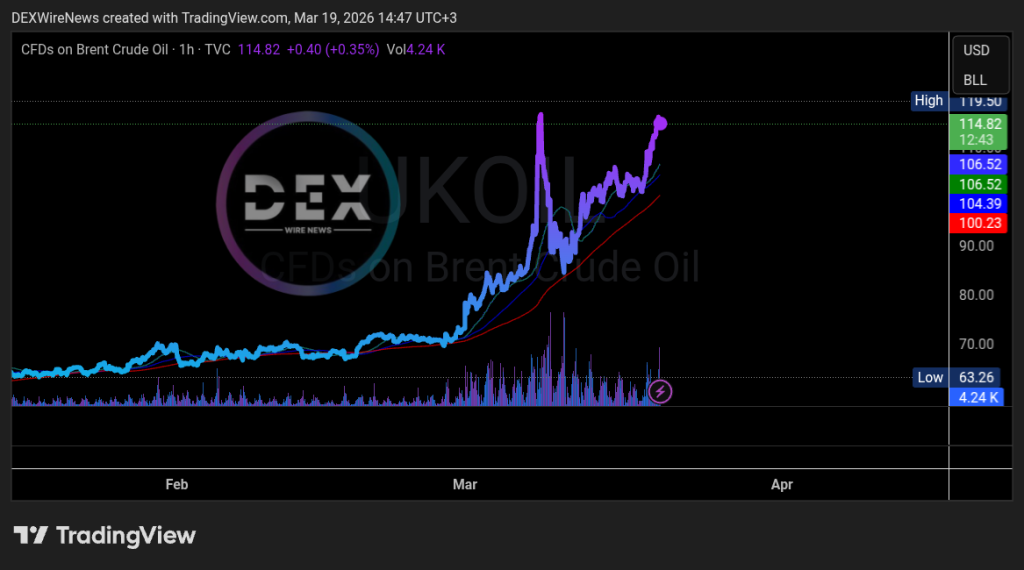
However, any credible de-escalation, diplomatic breakthrough, or confirmation that damage to Ras Laffan is repairable in weeks rather than months could trigger sharp profit-taking and a quick retracement toward $95–$100. Traders should maintain tight risk management. This is a headline-driven environment where one new strike or one diplomatic signal can cause 10–20% moves in either direction within hours.
Click Here for Updates on UKOIL – It’s 100% FREE to Sign Up for Text Message Notifications!
Disclaimer: This website provides information about cryptocurrency and stock market investments. This website does not provide investment advice and should not be used as a replacement for investment advice from a qualified professional. This website is for educational and informational purposes only. The owner of this website is not a registered investment advisor and does not offer investment advice. You, the reader / viewer, bear responsibility for your own investment decisions and should seek the advice of a qualified securities professional before making any investment. Please read our Full Disclaimer: https://dexwirenews.com/disclaimer/