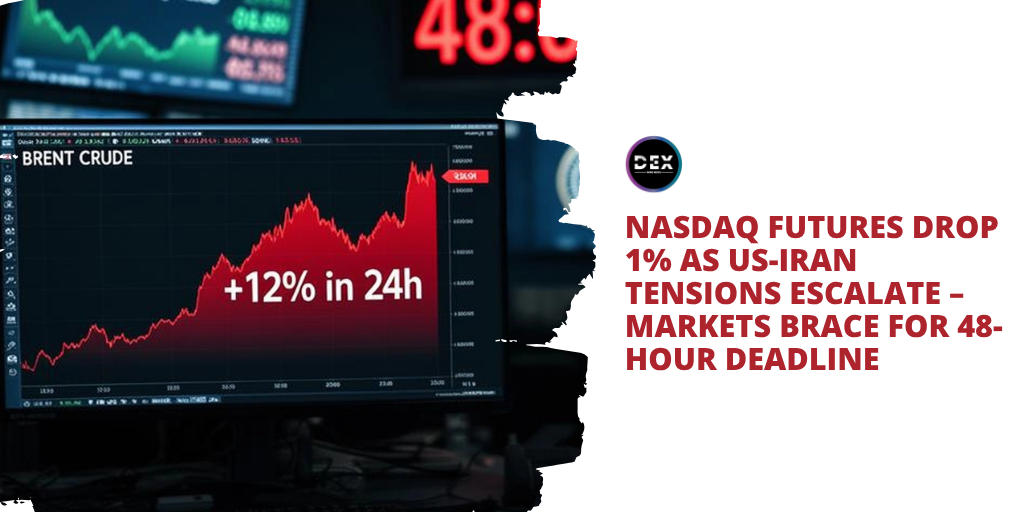
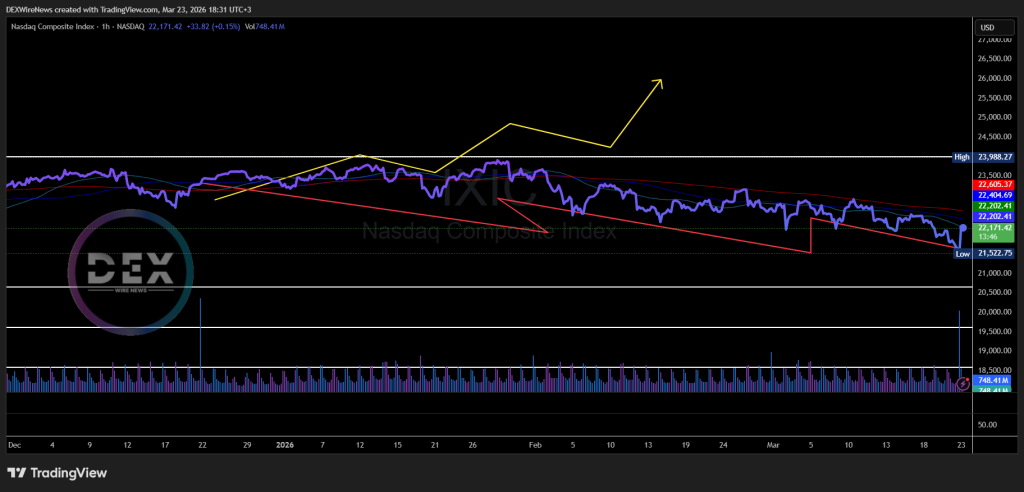
Nasdaq Composite futures (^IXIC) fell 1% in pre-market trading on March 23, 2026, with S&P 500 futures down 0.8% and Dow futures off 0.6%. The decline marks the fourth consecutive week of losses across major U.S. indexes: the Dow and Nasdaq each shed roughly 2% last week, while the S&P 500 lost 1.5%. For the Dow, this represents its first four-week losing streak since 2023. The selling pressure shows growing investor anxiety over the fast escalation between the United States and Iran, particularly following President Trump’s Saturday ultimatum demanding Tehran fully reopen the Strait of Hormuz within 48 hours.
Asian markets absorbed the initial shock from the weekend headlines, delivering severe declines. Japan’s Nikkei 225 plunged nearly 5%, while the broader Topix index fell 4.4%. South Korea’s Kospi also dropped more than 5%, extending a pattern of outsized moves in Asian equities during every major escalation in this conflict over the past four weeks.
Export-reliant Asian economies, especially Japan, which imports virtually all of its oil and gas, are structurally far more exposed to energy price shocks than their Western counterparts, turning every dollar increase in crude into a direct hit on corporate margins, consumer spending, and overall economic growth.
Trump’s Ultimatum and Iran’s Counter-Threat
On Saturday, President Trump explicitly warned that the United States would obliterate Iranian power plants if Tehran failed to reopen the Strait of Hormuz within 48 hours. Iran responded immediately, threatening to target U.S. energy and desalination infrastructure across the Gulf if any strike is carried out. The Strait, through which roughly 20% of global seaborne oil flows, has already been effectively closed for weeks due to the broader conflict. Each additional day of closure deepens the structural supply deficit, amplifying fears of prolonged disruption to global energy flows.
The rhetoric marks a dangerous new phase: each side is now openly threatening critical energy infrastructure rather than limiting engagement to military targets. Iran’s strategy appears focused on hitting the export capacity of U.S.-aligned Gulf states (Saudi Arabia, UAE, Qatar), applying broad economic pressure on the coalition instead of restricting retaliation to direct U.S./Israeli military assets.
This shift raises the risk of cascading strikes on oil fields, LNG terminals, and desalination plants, facilities whose loss would have immediate and severe global economic consequences.
Oil Creeps Higher While Equities Crack Key Levels
West Texas Intermediate futures rose 0.5% to $98.80 per barrel in early trading, while Brent advanced 0.5% toward $113. The moves remain relatively contained given the severity of the weekend rhetoric, suggesting oil markets have already priced in substantial conflict risk and are now waiting for confirmation of actual infrastructure strikes before repricing aggressively higher. The spread between Brent and WTI continues to widen, reflecting how concentrated supply disruptions in the Gulf affect international markets far more than U.S. domestic supply chains.
On the equity side, the S&P 500 broke below its 200-day moving average last week, the first such breach since May. This widely watched long-term trend indicator shifting below price puts the burden of proof squarely on bulls. Closing below the 200-day MA often triggers systematic selling from trend-following funds and algorithmic strategies, creating a self-reinforcing downside dynamic regardless of short-term developments that might otherwise provide relief.
Outlook & Verdict
Risk-off sentiment dominates heading into the critical 48-hour window. Any escalation involving power plants, desalination facilities, or renewed Strait of Hormuz disruption would likely send oil sharply higher (potentially toward $130–$150 in a worst-case scenario) and equities lower.
Conversely, diplomatic de-escalation or confirmation that key infrastructure remains intact could trigger short-covering relief rallies. Until clarity emerges, markets will remain headline-driven and highly volatile. Position sizing, tight stops, and disciplined risk management are essential. This is one of those rare multi-week geopolitical setups capable of reshaping global risk pricing in a matter of hours.
Click Here for Updates on AAUC – It’s 100% FREE to Sign Up for Text Message Notifications!
Disclaimer: This website provides information about cryptocurrency and stock market investments. This website does not provide investment advice and should not be used as a replacement for investment advice from a qualified professional. This website is for educational and informational purposes only. The owner of this website is not a registered investment advisor and does not offer investment advice. You, the reader / viewer, bear responsibility for your own investment decisions and should seek the advice of a qualified securities professional before making any investment. Please read our Full Disclaimer: https://dexwirenews.com/disclaimer/