SpaceX (SPAX.PVT) doesn’t behave like a normal company, so it makes sense that it isn’t entering the public markets in a normal way either. While most firms spend years teasing an IPO, SpaceX has quietly done something louder: it set an internal price that values the company at about $800 billion, instantly putting it in a league almost no private business has ever reached.
This wasn’t a marketing stunt. It was an insider share sale, the kind that usually happens when a company is confident enough in its future to let employees and early investors cash in at a high price. And behind that move sits a much larger idea: a possible IPO in 2026 that could dwarf every listing that came before it.
The Deal That Changed the Conversation
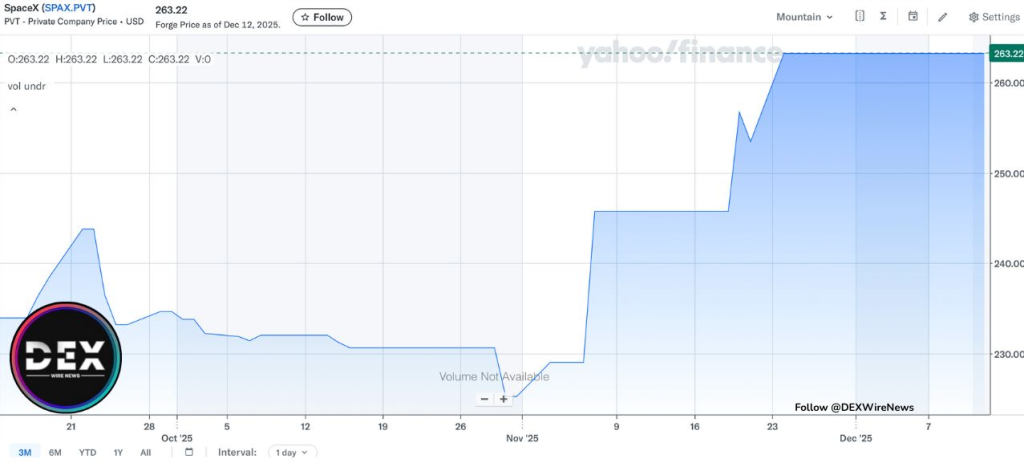
According to reports, SpaceX’s latest secondary transaction priced shares around $421 each, nearly double the level seen just months earlier when the company was valued near $400 billion. That single move pushed SpaceX past OpenAI’s recent private valuation and restored it as the most valuable closely held company in the world.
The message to shareholders, written by CFO Bret Johnsen, made one thing clear: SpaceX is actively preparing for a public offering, even if the timing isn’t locked in. The company conducts these tender offers twice a year, but this one felt different. It looked less like routine housekeeping and more like a dress rehearsal.
There was also a report that SpaceX was exploring an IPO that could raise well over $30 billion, a figure that would make it the largest public listing ever if it happens.
Why SpaceX Needs Public Markets
SpaceX isn’t going public to clean up its balance sheet or satisfy early investors. The company is thinking on a much bigger scale.
In the same internal communication, management described plans to fund what it called an “insane flight rate” for Starship, the next-generation rocket meant to carry humans to the Moon and eventually Mars. Beyond that, SpaceX is openly talking about AI data centers in orbit and the early foundations of a lunar base.
These are not cheap ambitions. Even with strong cash flow from launches and Starlink subscriptions, projects of this size demand access to deeper pools of capital. Public markets offer that, along with scrutiny, volatility, and pressure that SpaceX has never had to face before.
The Engines Behind the Valuation
The $800 billion figure isn’t built on hype alone. SpaceX dominates two critical areas of the modern space economy.
First is launch services. With Falcon 9, SpaceX has turned rocket launches into something closer to logistics than science experiments. It sends satellites, astronauts, and cargo into orbit at a frequency no competitor comes close to matching.
Governments, private companies, and space agencies rely on SpaceX because it works repeatedly.
Second, and arguably more important, is Starlink. The satellite internet network now spans thousands of satellites and serves millions of users worldwide. For investors, Starlink changes the SpaceX story. It changes the company from a project-based launcher into a recurring-revenue infrastructure business.
A Trillion-Dollar Target, Or Something Bigger?
Sources say SpaceX has internally discussed a $1.5 trillion valuation around the time of a potential IPO. That would place it near the territory Saudi Aramco occupied during its historic 2019 listing.
But even SpaceX acknowledges uncertainty. Johnsen explicitly noted that the IPO may not happen at all, depending on market conditions and execution. This isn’t a promise; it’s an option.
And execution matters. Starship still faces technical and regulatory hurdles. Starlink must continue scaling without crushing margins. Public investors are far less forgiving than private backers when timelines slip or costs spike.
What Makes This Moment Different
Plenty of private companies talk about going public “one day.” SpaceX is different because it’s already operating at a scale that rivals public giants, without public capital. The $800 billion valuation forces a re-rating of what the space economy is worth and who controls it.
If SpaceX does list in 2026, it won’t just be another tech IPO. It will be a referendum on whether markets are ready to price moonshots, orbital infrastructure, and interplanetary ambition, not as science fiction, but as financial reality.
For now, SpaceX remains private. But with this valuation, the countdown has clearly started.
Click Here for Updates on SPAX.PVT – It’s 100% FREE to Sign Up for Text Message Notifications!
Disclaimer: This website provides information about cryptocurrency and stock market investments. This website does not provide investment advice and should not be used as a replacement for investment advice from a qualified professional. This website is for educational and informational purposes only. The owner of this website is not a registered investment advisor and does not offer investment advice. You, the reader / viewer, bear responsibility for your own investment decisions and should seek the advice of a qualified securities professional before making any investment. Please read our Full Disclaimer: https://dexwirenews.com/disclaimer/