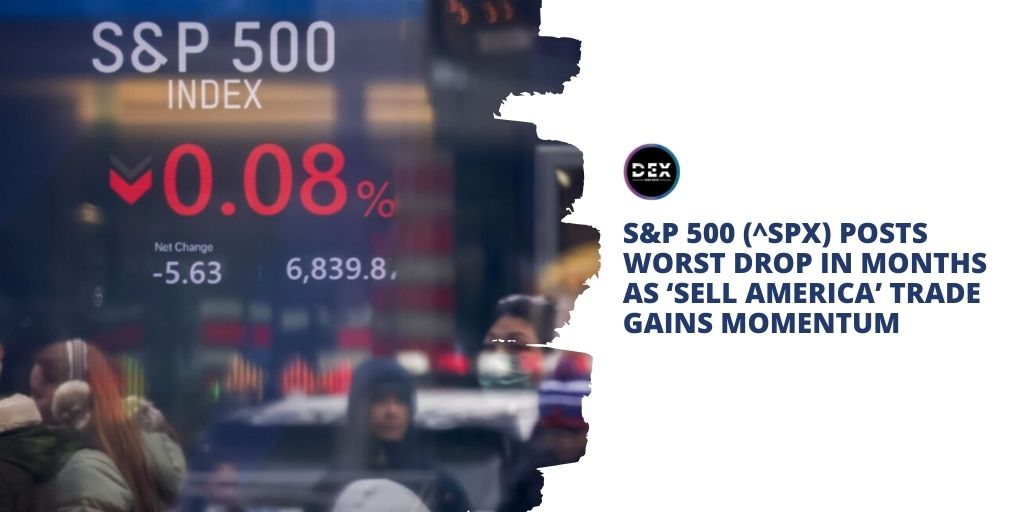
The S&P 500 (^SPX) slid sharply on Tuesday, recording its worst single-day drop in roughly four months as global markets reacted to renewed geopolitical and trade tensions. U.S. stocks fell broadly, with the S&P 500 dropping around 2%, while the Nasdaq Composite lost nearly 2.4% and the Dow Jones Industrial Average slid about 1.8%.
This sell-off was driven by a resurgence of the so-called “Sell America” trade, where investors reduce holdings in U.S. equities, bonds, and even the dollar amid fears over escalating tariff threats and geopolitical uncertainty.
The market’s movement reflects a growing concern that political tensions and trade policy risks could slow economic growth and corporate profits, especially for large U.S. companies. Traders have become increasingly sensitive to headlines, and recent events have amplified risk-off positioning across global asset markets.
What Sparked the Sell-Off
The renewed decline in U.S. stocks followed reports of tariff threats from U.S. political leadership targeting European partners unless specific concessions are made, a scenario that has rattled investors and raised concerns about prolonged trade disruptions.
This diplomatic strain prompted a broad de-risking across markets, pushing traders to rotate out of equities and into traditional safe havens like gold, which hit fresh highs, and cash-like instruments.
The sell-off wasn’t limited to one sector. While technology shares and the so-called “Magnificent Seven” contributed to the downside due to their heavy market weighting, the drop was felt across industrials, financials, and consumer stocks, reflecting a wide-based retreat from risk.
Macro Drivers and Global Risk Appetite
Beyond tariff headlines, broader macro factors helped reinforce risk-off sentiment. Treasury yields moved higher, suggesting investors were repricing the outlook for interest rates and growth given the uncertainty. A weaker U.S. dollar also emerged as part of the broader shift, as overseas investors reduced dollar-denominated exposure in favor of other currencies.
The combination of geopolitical tension, yield shifts, and weaker risk appetite has made markets more sensitive to negative news flows. Sentiment indicators like the Cboe Volatility Index (VIX) rose sharply, showing that traders are bracing for potential continued turbulence rather than immediate stabilization.
Investor Behavior and the ‘Sell America’ Theme
The phrase “Sell America” has resurfaced among traders to describe a trend where U.S. assets, stocks, bond holdings, and even the dollar, are sold broadly amid fears that U.S. geopolitical and trade policy risks could weigh on growth. According to market commentary, this trade has picked up as investors hedge positions and rebalance toward safer or foreign assets when U.S. policy uncertainty spikes.
This behavior contrasts with earlier periods where strong U.S. equity performance and relatively stable policy environments kept investor confidence high. The renewed focus on U.S. external relations and trade tensions appears to have weakened that conviction in the short term.
What Traders Are Watching Next
Looking ahead, traders are focused on several key signals that could help determine whether the recent sell-off continues or stabilizes:
- Geopolitical developments and trade negotiations can influence risk appetite quickly.
- Treasury yield movements often guide equity risk pricing and corporate borrowing costs.
- Economic data releases, including inflation and employment reports, could impact interest rate expectations.
If risk-off sentiment persists or escalates further, markets could revisit key support levels; if calm returns or diplomatic progress unfolds, equities may find a floor and begin to recover.
The S&P 500’s sharp decline marks its worst performance in months, driven by the reappearance of the “Sell America” trade, renewed geopolitical tensions, and shifting market psychology.
Broad equity weakness, rising volatility measures, and movements in safe-haven assets like gold underline how sensitive global markets have become to political and macroeconomic uncertainty.
Click Here for Updates on SPX – It’s 100% FREE to Sign Up for Text Message Notifications!
Disclaimer: This website provides information about cryptocurrency and stock market investments. This website does not provide investment advice and should not be used as a replacement for investment advice from a qualified professional. This website is for educational and informational purposes only. The owner of this website is not a registered investment advisor and does not offer investment advice. You, the reader / viewer, bear responsibility for your own investment decisions and should seek the advice of a qualified securities professional before making any investment. Please read our Full Disclaimer: https://dexwirenews.com/disclaimer/