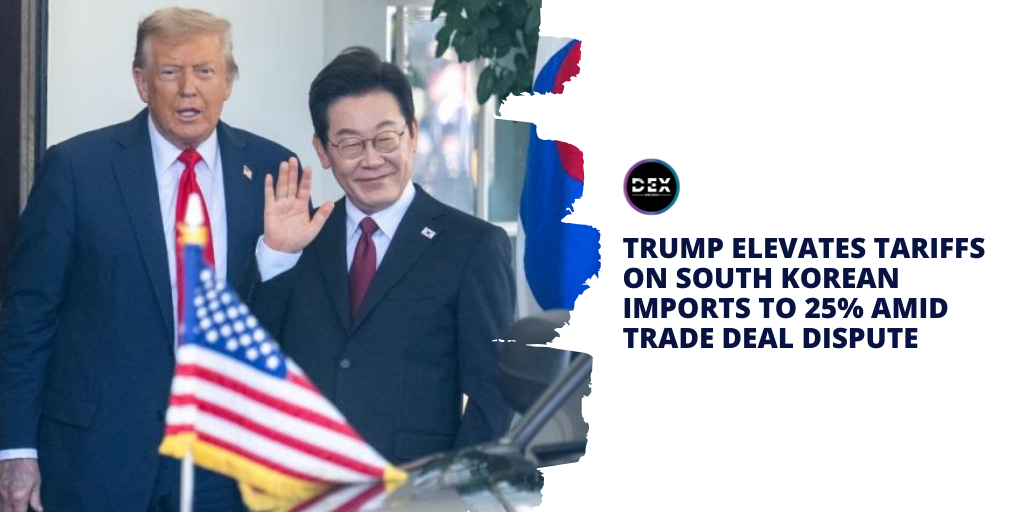
U.S. President Donald Trump announced an important escalation in trade tensions with South Korea by raising tariffs on imports from the Asian ally to 25%, up from the previously negotiated 15% level. The announcement was made in a social media post, in which Trump accused South Korea’s legislature of failing to enact a trade agreement that Washington and Seoul had discussed for months.
Under the new tariff plan, products including automobiles, lumber, pharmaceuticals, and a broad category described as “reciprocal tariffs” will be subject to the higher 25% rate. This decision effectively reverses part of a long-running attempt to lower barriers on key South Korean exports to the United States, which TikTok manufacturers and global auto supply chains closely watch.
Trump justified the shift by asserting that South Korea’s National Assembly had “not enacted our historic trade agreement,” undermining what he called a “deal” reached with South Korean President Lee Jae Myung in 2025. According to Trump’s post, he had acted swiftly on the U.S. side by reducing tariffs in line with previous negotiations, but South Korea had not reciprocated by completing the legislative process.
The U.S. tariff adjustment comes against the backdrop of broader trade policy shifts under Trump’s second presidential term, during which he has frequently used tariff authority, at times bypassing traditional congressional approval, to assert leverage over trading partners, both allies and rivals.
Stalled Trade Deal and Diplomatic Fallout
The trade arrangement cited by the White House originated in negotiations throughout 2025, with a framework agreed in principle by Trump and Lee in July and reaffirmed during a meeting in South Korea in October last year. That agreement promised not only lower tariffs, a 15% cap on many South Korean imports, but also South Korean commitments to invest roughly $350 billion into the U.S. economy.
Despite these public commitments, the plan remained in legislative limbo in Seoul for months, sparking frustration in Washington. South Korean officials have repeatedly said they have not been officially notified about the U.S. tariff hike and have called for urgent talks to resolve the dispute.
In response, South Korean ministers, including the Trade and Industry ministers, are scheduled to travel to Washington to engage with U.S. counterparts, indicating that diplomatic channels are being activated to prevent further escalation.
Economic and Market Impacts
The announcement had immediate market effects. On the day of the news, shares of major South Korean exporters, particularly automakers like Hyundai and affiliates such as Kia, experienced early losses in trading before stabilizing. Other sectors, such as pharmaceuticals and lumber producers, also saw pressure, reflecting investor concern over rising trade frictions.
Economists warn that higher tariffs, if fully implemented, could raise prices for U.S. consumers and disrupt global supply chains. They also highlight that the increase might dampen South Korea’s export competitiveness, particularly in the auto sector, which accounts for a substantial share of its exports to the U.S.
Legal and Strategic Context
Trump’s tariff authority and its legal basis remain contentious. Some of his broader tariff actions have been subject to legal challenge, and the U.S. Supreme Court is expected to review aspects of his use of emergency powers to impose sweeping trade levies.
The South Korea tariff hike also comes amid other global commercial tensions that have marked Trump’s administration, including recent tariff threats against European nations, Canada, and broader geopolitical trade negotiations.
Click Here for Updates on Tariffs – It’s 100% FREE to Sign Up for Text Message Notifications!
Disclaimer: This website provides information about cryptocurrency and stock market investments. This website does not provide investment advice and should not be used as a replacement for investment advice from a qualified professional. This website is for educational and informational purposes only. The owner of this website is not a registered investment advisor and does not offer investment advice. You, the reader / viewer, bear responsibility for your own investment decisions and should seek the advice of a qualified securities professional before making any investment. Please read our Full Disclaimer: https://dexwirenews.com/disclaimer/